

F-series History
F-Series History with Stanley Ford Eastland
For decades Ford has ranked at the top of the market for the F-Series pickup trucks it has produced. The design evolved over the years to incorporate changes in technology, but the premise is still the same: build a tough truck that appeals to the everyday driver to handle tough jobs. This mission has not changed in decades, but how it is approached gets better.How Did it Begin?
The F-Series was first introduced in the 1948 model year. Ford built this model with five body styles and eight weight ratings to appeal to a broad spectrum of buyers. The F series started out with F-1, F-2, F-3, etc. but it changed with the second generation and still applies today. The F-1 soon became the F-100, the F-2 was combined with the F-3 to become the F-250 and then the F-4 became the F-350.The third generation produced more changes with the new Styleside bed, and the body became lower and longer. Current engines were replaced with more powerful versions and space and comfort were added to the cabins. It wasn’t until the sixth generation that the highly popular F-150 joined the lineup.
The seventh generation started during the 1980s and came with a complete redesign, featuring a dual rear-wheel model.
Generation Nine
This generation was given a brand-new look, which would be the foundation for future designs. Ford lowered the hoodlines and rounded the grilles, front bumpers, and front fenders to create a more contemporary look. To celebrate the historic year, Ford released a 75th anniversary package in 1992, which featured special logos and striping.Generation Ten
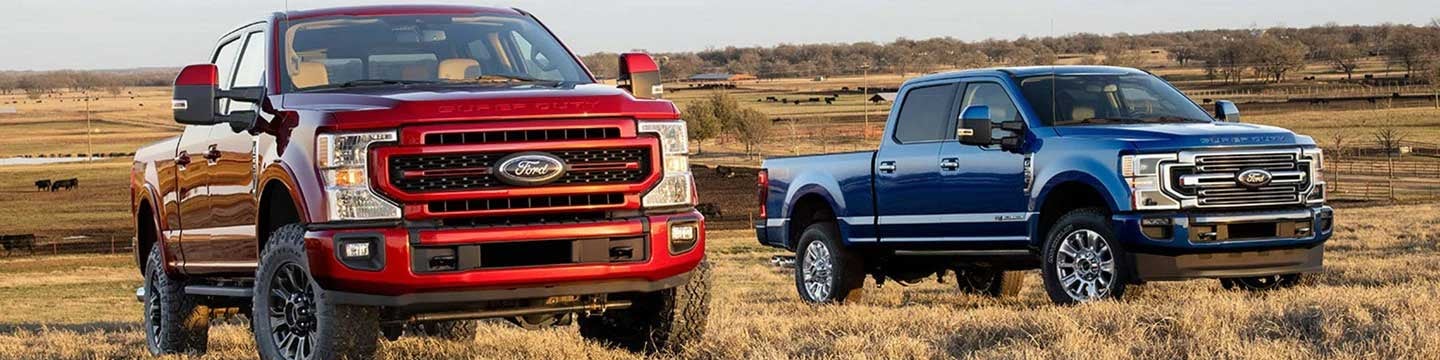
1997 brought about a major change to the F-series trucks. Ford divided the models into two separate and distinct categories. The F-150 was a passenger truck for working around the farm, going off-road or transporting families. Meanwhile, the F-250 and F-350 were christened as part of the heavy-duty lineup as work vehicles. Two years later these trucks would be renamed as Super Duty pickups.Generation Eleven
In 2004 Ford did another complete redesign of the F-series with a new platform topped by a fully boxed-in frame. Rear shocks for the F-150 were also added at this time. In 2008, the Super Duty line was built onto a new platform with a larger grille, new headlights, and a new cabin.Generation Twelve
The twelfth generation brought an all-new lineup of engines for the F-Series. They were the new V8, a new 3.6L V6, and a twin Turbo-charged 3.5L V-6 which would be called an EcoBoost. These had automatic transmissions as standard for all three engines.Generation Thirteen
Ford revamped the F-Series with a lighter build at this time to reduce workload on the engines, making them a more efficient design. Towing capacity was not affected to ensure the trucks could handle whatever task was necessary. Newer engine designs were switched for the old ones and six-speed transmissions were standard. Advanced safety features were added as options for these models. Including pre-collision assist with pedestrian detection and adaptive cruise control with stop and go.Generation Fourteen
These are the current models on the market today with several changes to both the interior and the exterior. More advanced safety features were added with new active driver assistance to help the driver on the road. One of the latest and greatest changes is the development of the F-150 Lightning, the first fully electric Ford pickup truck.To find out more about the Ford F-Series, visit Stanley Ford Eastland, proudly serving Eastland, Cisco, and Ranger.

May not represent actual vehicle. (Options, colors, trim and body style may vary)